Mission: Reclaim the Internet
If you feel betrayed by the internet,
there is nothing wrong with you.
There is something wrong with them.
The internet has been hijacked.
Big tech has taken the gift of the internet, a once wonderful environment where communication, ideas, information and commerce could flourish, and slowly but surely centralised power, truth and money into the coffers of the elites, to the direct detriment of all the world’s peoples.
The Promise
Remember the Old Internet?
There was a moment, not so long ago, when the internet felt like the most important invention in human history. It was not hyperbole. For the first time, ordinary people had access to the same information as the powerful. Small businesses could reach the world. Strangers could find their people. Ideas could travel at the speed of light, unfiltered and uncontrolled.
“The internet was supposed to be the great equaliser. A decentralised network of networks, owned by no one and available to everyone. A place where the best idea wins, not the biggest wallet.”The original promise of the open web, 1993-2010
1991 – 1999
The Open Frontier
Tim Berners-Lee releases the World Wide Web to the public domain for free. No patents. No licences. A gift to humanity. The early web is raw, weird, and genuinely democratic.
2000 – 2007
The Creative Explosion
Blogs, forums, Wikipedia, and open-source software flourish. Anyone can publish. Anyone can be found. Google’s early search genuinely surfaces the best content. The web rewards quality.
2007 – 2012
The Peak: Connection at Scale
Social media arrives and, for a brief moment, it is genuinely good. Facebook connects families. Twitter gives a voice to the voiceless. YouTube democratises video. The smartphone puts the open web in every pocket.
2012 – Present
The Walls Go Up
The platforms, now dominant, begin to change. Algorithms replace chronological feeds. Organic reach collapses. Advertising floods every surface. The open web is quietly replaced by a handful of walled gardens, each extracting more than they give.
“The productivity gains from the internet peaked somewhere between 2010 and 2020. Since then, the rent-seekers took over.”
The Mechanism
They Did Not Break It by Accident.
In 2022, Canadian author and digital rights activist Cory Doctorow gave a name to what we had all been feeling. He called it enshittification. It was named Word of the Year by both the American Dialect Society and Australia’s Macquarie Dictionary. The word spread because it was true.
“Here is how platforms die: first, they are good to their users; then they abuse their users to make things better for their business customers; finally, they abuse those business customers to claw back all the value for themselves. Then, they die.”Cory Doctorow, Wired Magazine, January 2023
This is not a bug. It is the business model. Every major platform follows the same three-stage playbook:
Seduce the Users
Offer a genuinely great service for free. Subsidise it with venture capital. Get everyone on board. Make it indispensable. Build the lock-in before anyone notices the walls going up.
Facebook 2008: Free, fun, connecting friends and family. No ads. No algorithm. Just people.
Exploit the Businesses
Users are trapped by network effects. Now turn to the businesses who need to reach them. Sell access. Raise fees. Rig the algorithm so organic reach collapses and only paid promotion survives.
Facebook 2014: Pages that once reached 100% of followers now reach 2%. Pay to boost, or be invisible.
Extract Everything
Everyone is locked in. Users cannot leave without losing their community. Businesses cannot leave without losing their customers. Now extract maximum value for shareholders, regardless of the damage done.
Facebook 2020+: Ads everywhere. Outrage algorithms. Data harvesting. Teen mental health crisis. $1.7 trillion market cap.
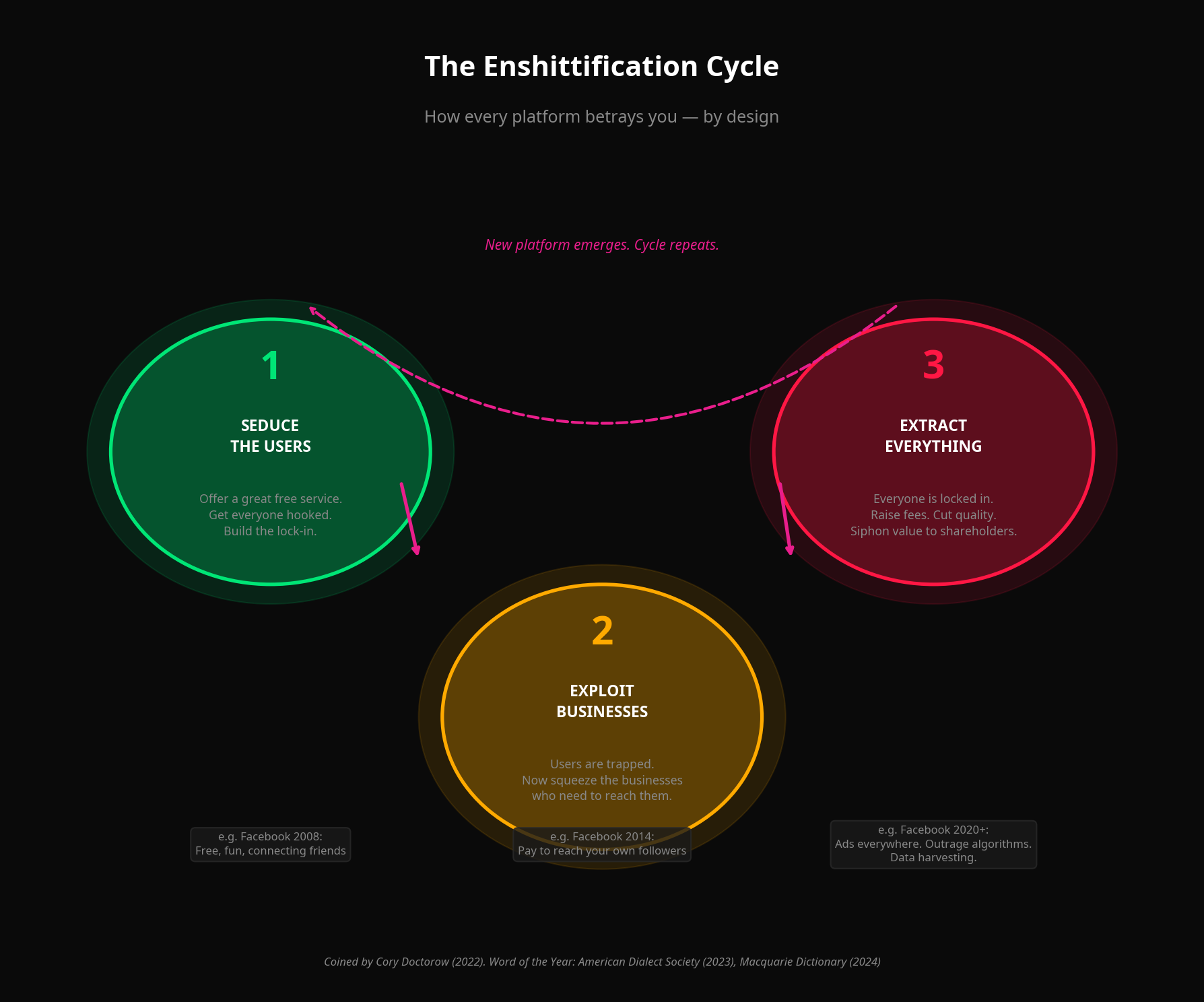
The Enshittification Cycle, as coined by Cory Doctorow (2022). Word of the Year: American Dialect Society (2023) and Macquarie Dictionary (2024). This diagram is illustrative of the documented pattern of platform decay.
Doctorow describes the process as “twiddling”: the continual, invisible adjustment of platform parameters in search of marginal profit improvements, with no regard for users, creators, or truth. It is rent-seeking dressed up as innovation.
The Accused
Let’s Name Some Names.
These are not abstract forces. They are specific companies, run by specific people, who made specific decisions to extract value from you. The evidence is public. The harm is documented. The names deserve to be said out loud.
The Search Engine That Stopped Searching
- A 2024 study by German researchers at the Webis Group confirmed what millions already knew: Google search results have measurably declined in quality over the past decade, flooded with SEO spam and AI-generated content.
- Google earns approximately $175 billion per year from search advertising. The more ads on the page, the less room for genuine results. The incentives are perfectly misaligned with your interests.
- In 2025, a US federal judge ruled that Google holds illegal monopolies in online advertising technology, finding the company had “willfully acquired and maintained” monopoly power in multiple ad markets.
- Google pays Apple an estimated $20 billion per year to remain the default search engine on iPhones, a payment that a federal court found in 2024 was itself an illegal monopoly-maintenance strategy.
Apple
The Toll Booth on the Digital Highway
- Apple charges a 30% commission on every app sale and in-app purchase made through the App Store, the only way to install software on an iPhone. Developers have called it “the Apple tax.” A federal court found in 2025 that Apple willfully violated an injunction ordering it to allow developers to link to external payment options.
- In 2024, Apple’s App Store generated an estimated $96 billion in services revenue, a significant portion of which comes directly from developer commissions. In the US alone, developers generated $33.68 billion in gross revenue, of which Apple kept over $10 billion.
- The European Commission found Apple non-compliant with the Digital Markets Act in April 2025, ruling it had not genuinely opened its ecosystem to competition despite being legally required to do so.
- Apple’s “walled garden” means your app data, your purchases, and your subscriptions are locked inside Apple’s ecosystem. Switch to Android and you lose everything you have paid for.
Microsoft
The Company That Turned Ownership Into a Monthly Bill
- For decades, Microsoft Office cost a one-time fee of approximately $149. You bought it. You owned it. It worked forever. In 2011, Microsoft introduced Office 365 subscriptions and has been systematically eliminating the perpetual licence option ever since.
- Microsoft 365 Personal now costs $99.99 per year in the US, raised from $69.99 in January 2025, the first increase in 12 years. A further increase of up to 16.7% is planned for July 2026. Over five years, you will pay more than three times the old one-time price for the same software.
- The Australian Competition and Consumer Commission (ACCC) launched an investigation in 2025 into whether Microsoft deceived consumers by bundling unwanted AI features (Copilot) into subscriptions and raising prices without adequate disclosure.
- Microsoft’s support model has become a labyrinth designed to exhaust you into giving up. Automated systems, offshore call centres, and community forums staffed by volunteers have replaced the human support that once came with a product you owned.
Amazon
The Marketplace That Became the Landlord
- In 2023, Cory Doctorow documented that over 45% of the sale price of items on Amazon goes to Amazon in the form of fees, commissions, fulfilment charges, and advertising costs, up from approximately 19% in 2014. Sellers have no choice but to participate, because Amazon is where the customers are.
- Amazon’s advertising business, which allows sellers to bid against each other for search ranking, generated $56.2 billion in 2024. The result is that the products shown first on Amazon are not the best products. They are the products with the largest advertising budgets.
- Amazon has been repeatedly accused of using third-party seller data to develop competing private-label products, then using its control of the platform to promote its own products over those of the sellers whose data it used. A 2020 Wall Street Journal investigation documented this practice in detail.
- The US Federal Trade Commission filed an antitrust lawsuit against Amazon in 2023, alleging it illegally maintained monopoly power by punishing sellers who offered lower prices elsewhere and degrading the quality of search results to force more advertising spend.
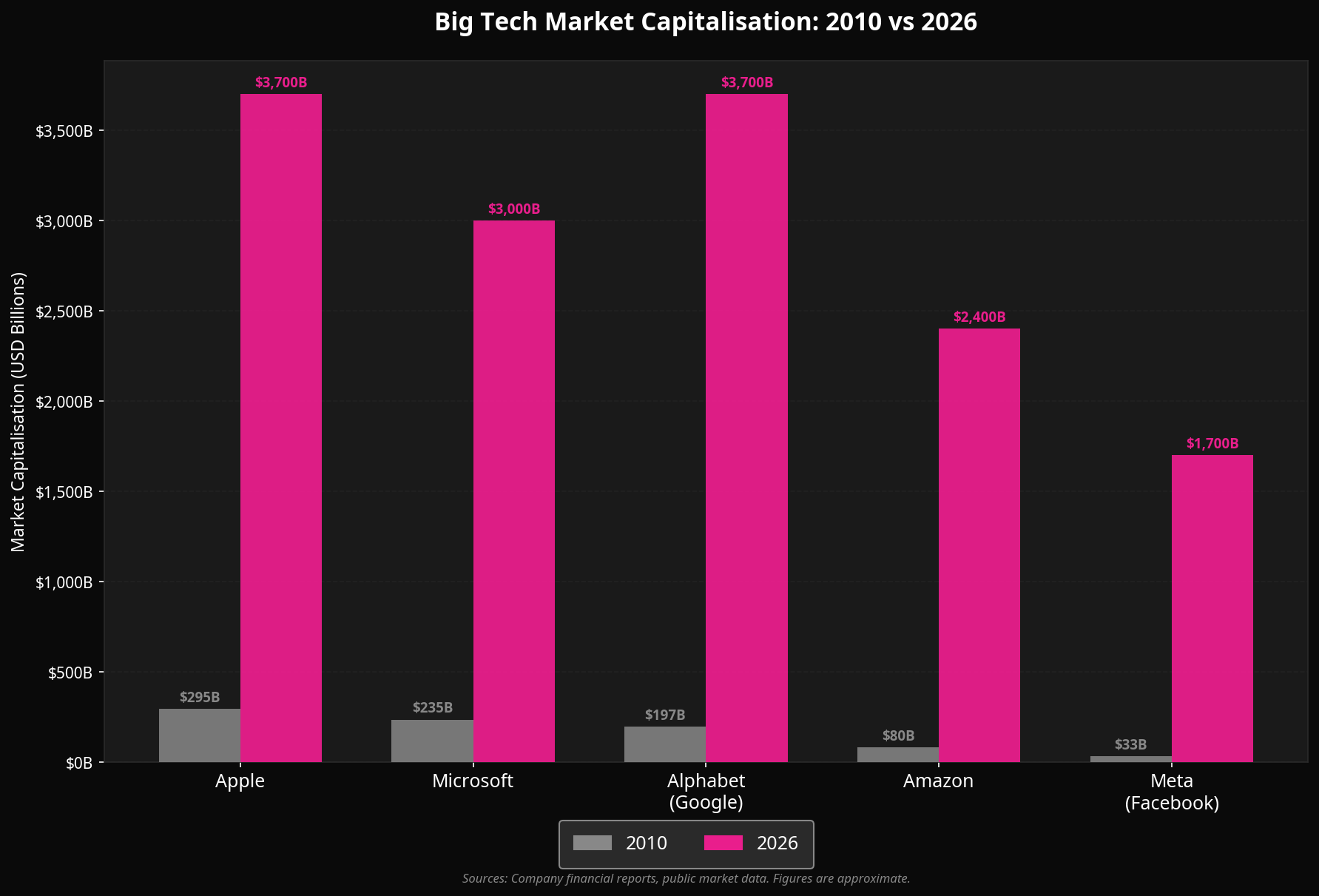
Big Tech Market Capitalisation: 2010 vs 2026. Sources: Company financial reports, public market data. Figures are approximate.
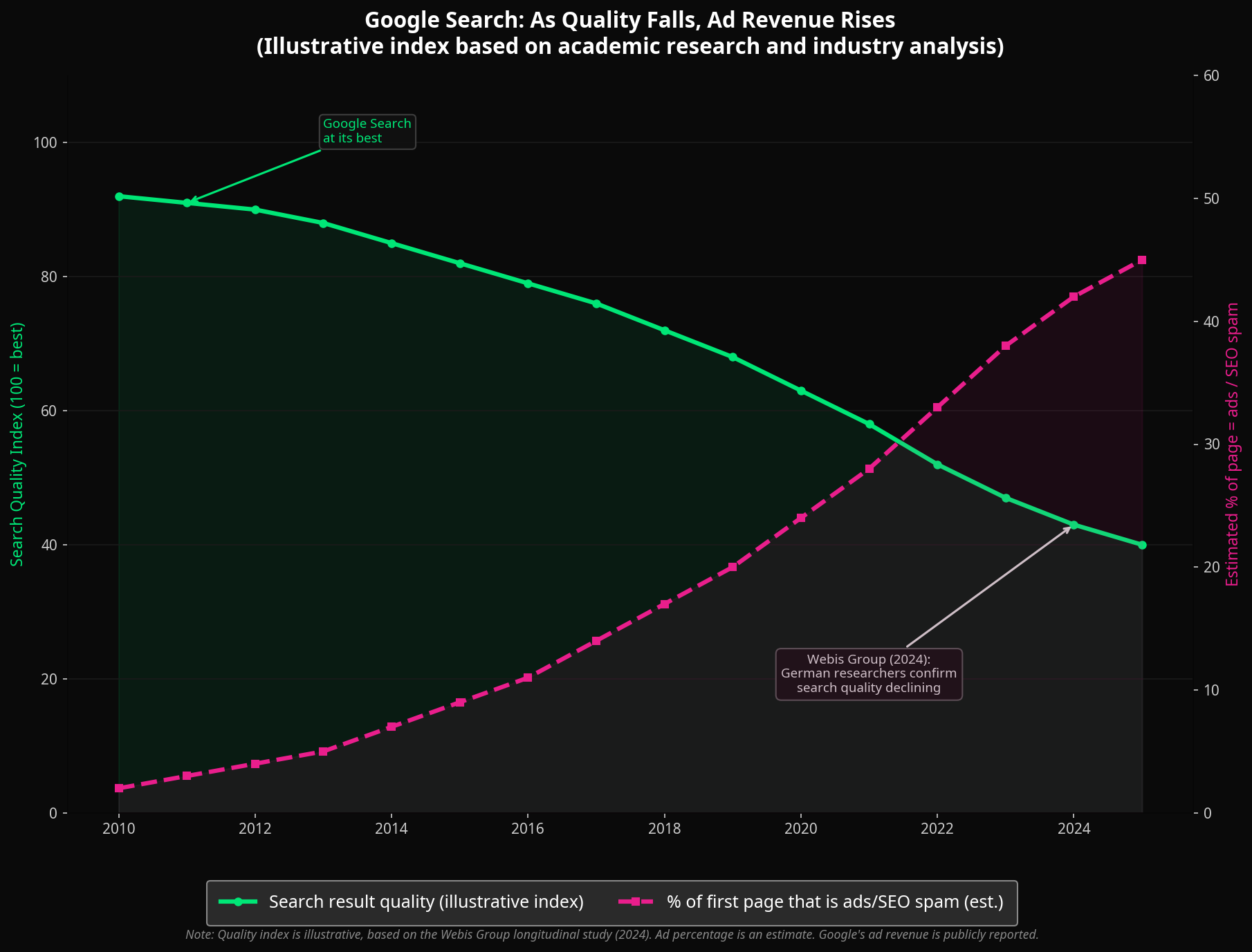
Google Search quality decline vs. ad revenue growth. Quality index is illustrative, based on the Webis Group longitudinal study (2024) and industry reporting. Ad revenue figures are from Alphabet annual reports.
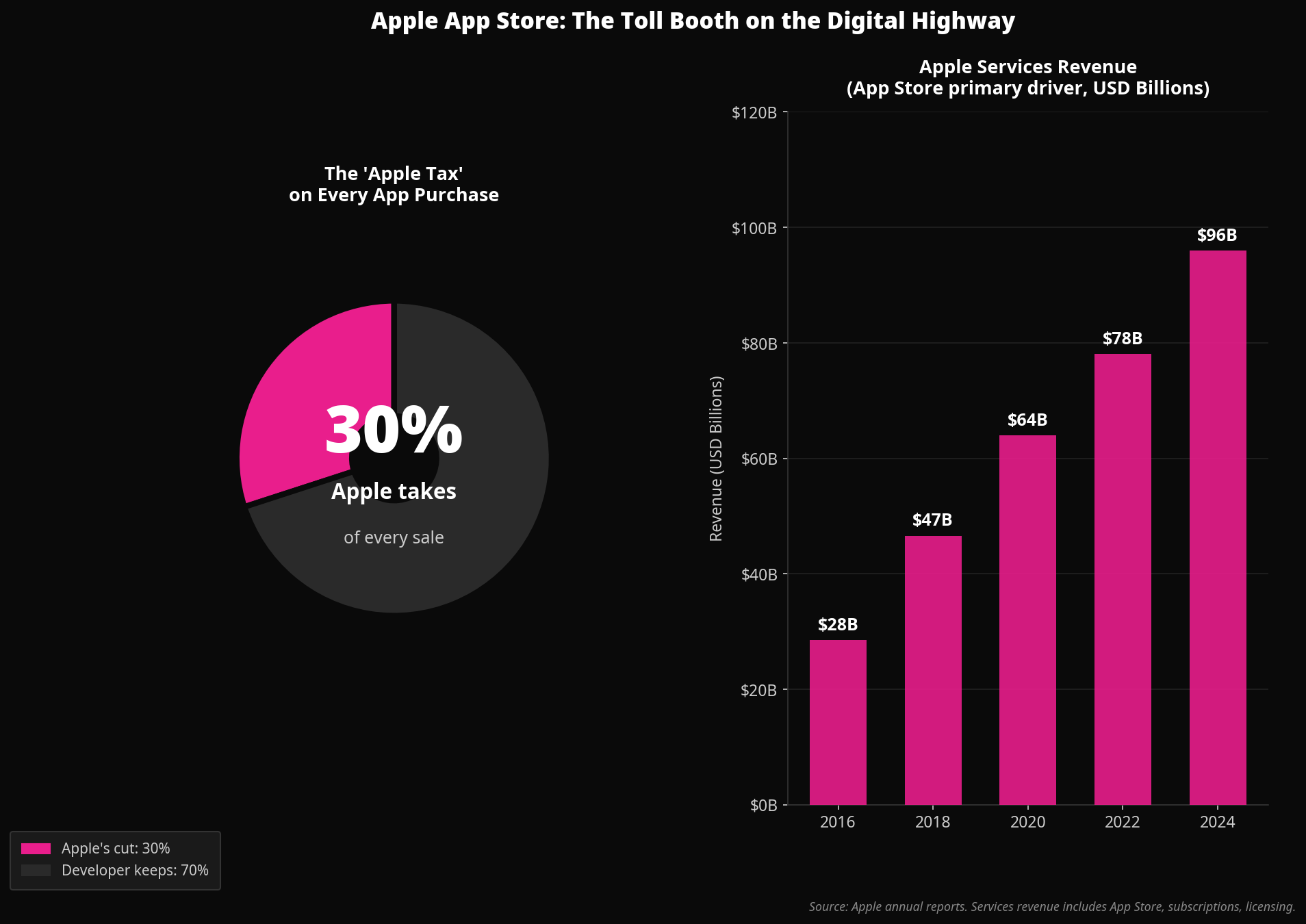
Apple’s App Store commission structure and services revenue growth. Source: Apple annual reports, Appfigures (2025). In the US alone, Apple kept over $10 billion from developer revenue in 2024.
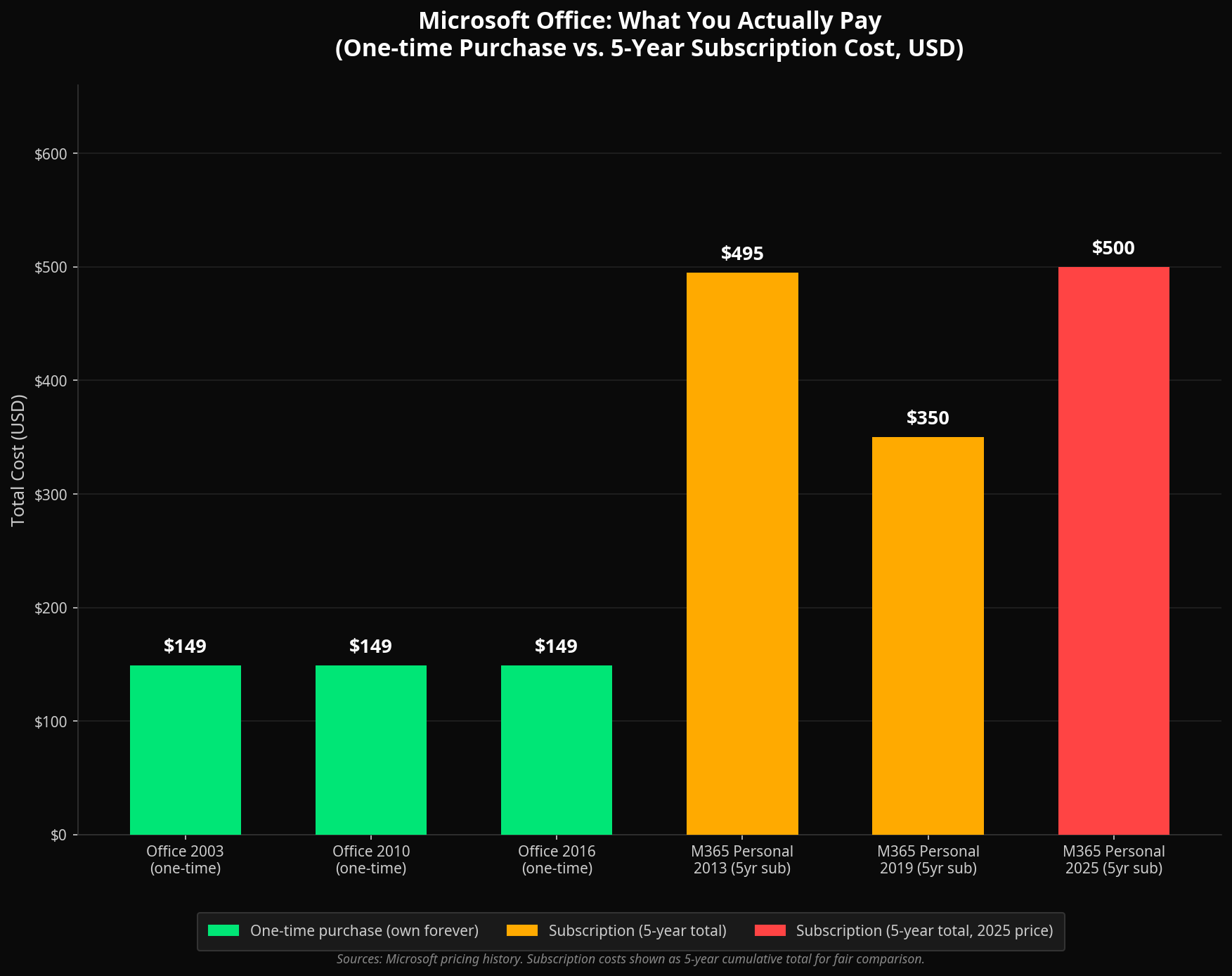
Microsoft Office: one-time purchase cost vs. 5-year cumulative subscription cost. Source: Microsoft pricing history. The 2025 price of $99.99/year means a 5-year subscriber pays $500 for software that once cost $149 outright.
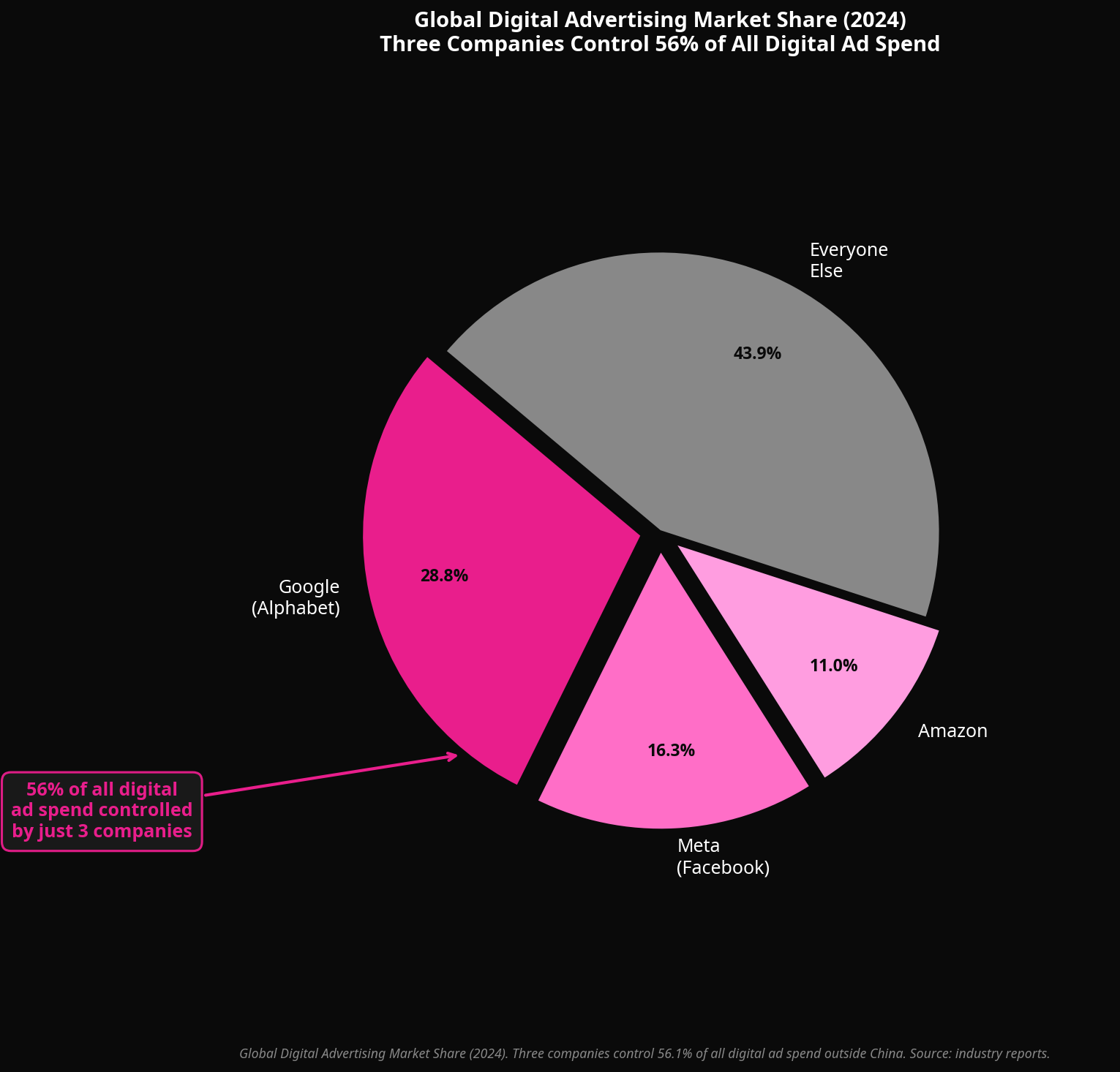
Global Digital Advertising Market Share (2024). Three companies control 56.1% of all digital ad spend outside China. Source: industry reports.
“A US federal judge ruled in 2025 that Google holds illegal monopolies in online advertising technology. This was not an accident. It was a strategy.”
The Physical World
Now They Are Coming for Your Stuff.
The enshittification playbook has escaped the internet. It has infected your car, your speakers, your exercise bike, your printer, and your home appliances. The pattern is identical: sell you the hardware at a reasonable price, wait until you are dependent on it, then lock the features you already paid for behind a monthly subscription.
This is not a metaphor. The hardware is physically installed in your car. The heated seats are there. The wiring is there. BMW simply decided that activating what you already own should cost you $18 per month. Tesla removed the Autosteer feature from older vehicles in January 2026 and told owners they would need to re-subscribe to get it back. Sonos pushed a software update in May 2024 that removed features from speakers customers had already paid hundreds of dollars for. The CEO later resigned.
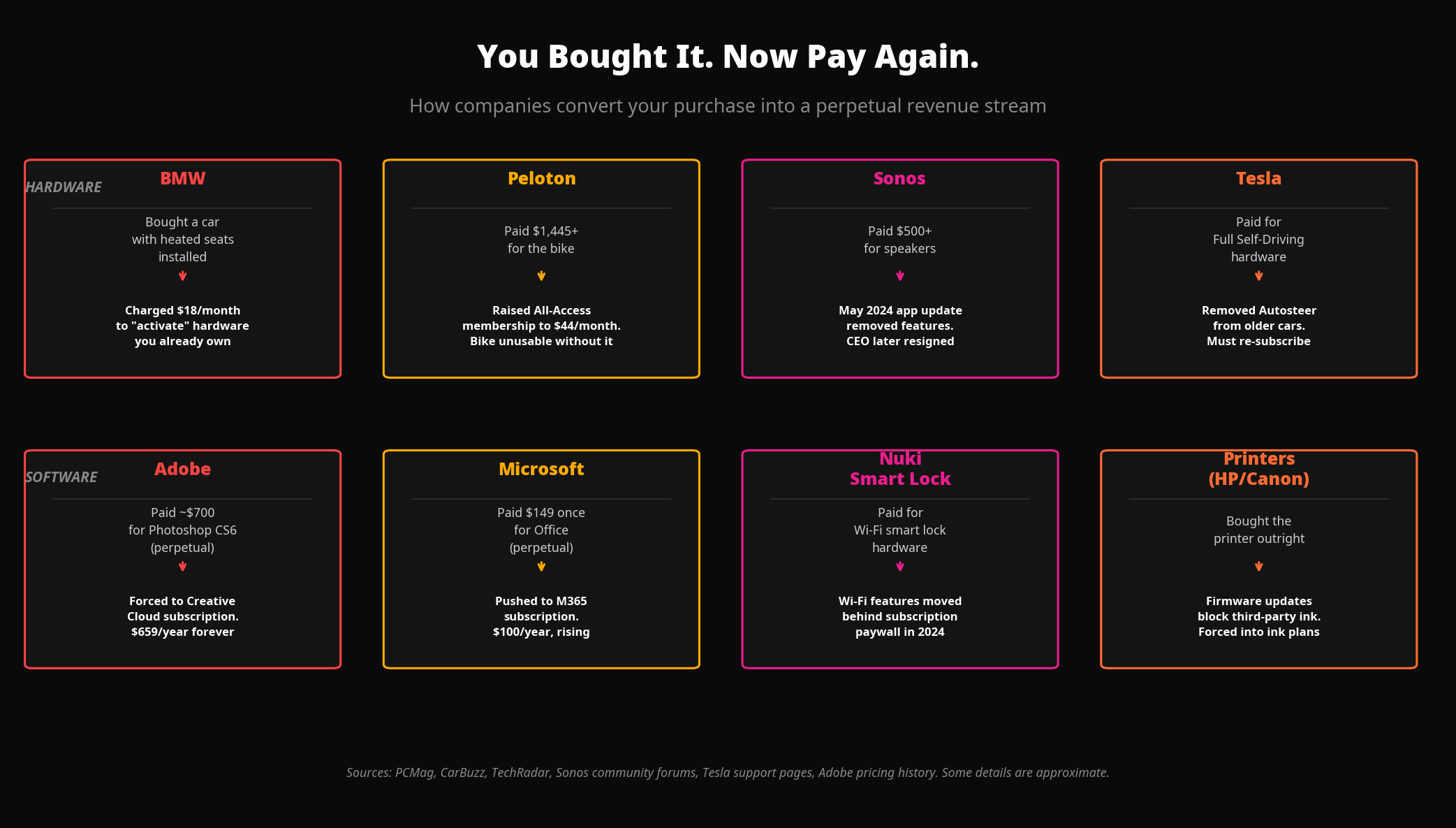
Documented examples of companies converting one-time purchases into recurring subscription revenue. Sources: PCMag, CarBuzz, TechRadar, Sonos community forums, Tesla support pages, Adobe pricing history. Some details are approximate.
“Monthly fees are crawling out of your browsers and into your devices that never had paywalls before. Car companies tried offering heated seats as a subscription. Printers refuse third-party ink. Smart locks put Wi-Fi behind a paywall. We are witnessing the largest wealth transfer in consumer history.”US PIRG (Public Interest Research Group), April 2024
The logic is always the same. First, they need you to buy the hardware. So the hardware is priced to sell. Then, once you are committed, once the device is in your home or your driveway, once switching would mean buying something new, they introduce the subscription. The hardware becomes a hostage. Your own property is held ransom.
The technical term for this is lock-in. Doctorow calls it the “kill switch”: the ability of a platform to degrade or remove the value of something you have already paid for, because they know you have no easy way out.
The Human Cost
This Is Not Just About Money.
The enshittification of the internet is not merely an economic story. It is a story about what happens to human beings when the information environment they live in is deliberately engineered to maximise engagement over truth, outrage over understanding, and addiction over well-being.
of teenagers say social media harms people their age
Pew Research Center, April 2025
They Knew. They Did Nothing.
In 2021, Facebook whistleblower Frances Haugen presented Congress with internal company research showing that Facebook’s own scientists had documented the harm their platforms were causing, particularly to young women. The company’s response was to suppress the research and continue optimising for engagement.
This is not a side effect. It is the product. Algorithms that maximise engagement will always favour outrage, fear, and division, because those emotions keep people scrolling. A 2024 study in Science found that misinformation exploits outrage to spread online, and that platforms had been warned about this dynamic for years.
The internet was supposed to make us more informed. Instead, it has been weaponised to make us more afraid, more angry, and more dependent on the very platforms that are profiting from our distress.
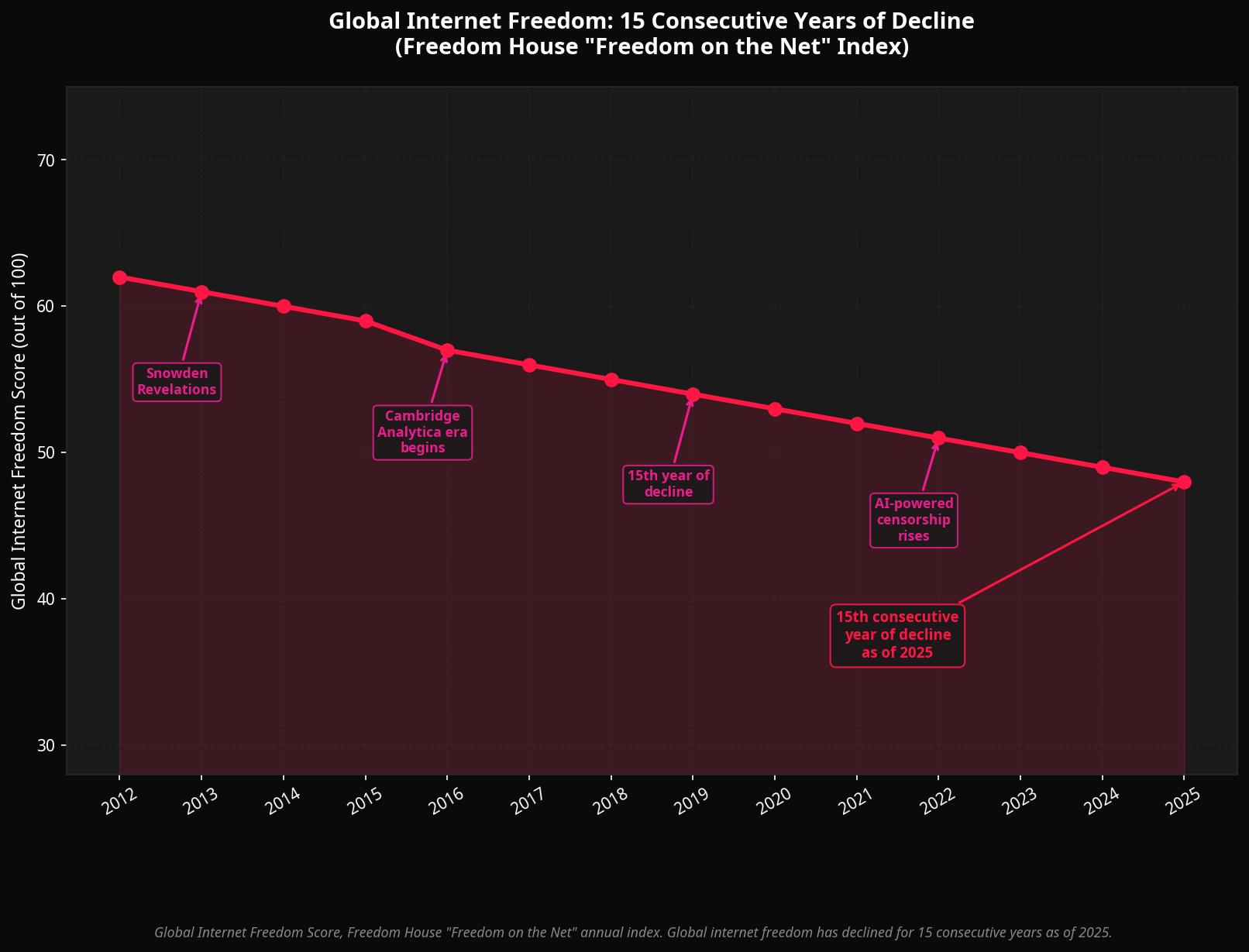
Global Internet Freedom Score, Freedom House “Freedom on the Net” annual index. Global internet freedom has declined for 15 consecutive years as of 2025.
“Enshittification can be seen as a form of rent-seeking.” Platforms that act as intermediaries can act as both a monopoly on services and a monopsony on customers, as high switching costs prevent either from leaving even when alternatives technically exist.
The Way Out
Step Back. Ask the Question.
The first step is not technical. It is not about downloading a new app or switching browsers. The first step is a moment of genuine pause, a single question asked honestly:
“Do I actually need to be on this platform? Is there a real alternative?”
For most people, the honest answer is: probably not, and yes there is. The rent-seekers have done an extraordinary job of making their products feel indispensable. They are not. The good old internet is still out there. It never went away. It just got buried under the advertising.
A Personal Note from Bryce
The Day I Quit Microsoft Office
For years I paid Microsoft’s subscription. Every year the price went up. Every year the software got slower, more cluttered, more insistent about connecting to the cloud, more aggressive about selling me things I did not need. The support, if you could call it that, had become a labyrinth of automated responses and community forums staffed by volunteers. There was no human being to call. There was no one who cared.
The moment of clarity came when I asked myself a simple question: what does Microsoft Office actually do that I cannot do elsewhere? The answer was: nothing. Absolutely nothing that matters for 99% of what I do every day.
I downloaded LibreOffice. It is free. It is open source. It runs offline. It opens every Microsoft file format. It does not phone home. It does not require a subscription. It does not have an AI assistant watching what I type. It just works, exactly the way software used to work before the rent-seekers arrived.
That was my “aha” moment. Not a dramatic act of rebellion. Just a quiet realisation that for every horrible, expensive, slow, zero-support subscription, there is always an indie alternative, built on the structure of the good old internet we used to love. Open. Free. Owned by no one. Answerable to its users.
The Framework: Three Questions Before Every Platform
Apply this to every subscription, every app, every platform you use.
Do I actually need this?
Not “is it convenient” or “is it familiar.” Do I genuinely need it? Most subscriptions survive on inertia, not necessity. Cancel it for a month. See what you miss. You will be surprised how little it is.
Is there a free alternative?
There almost always is. The open-source community has been building free alternatives to every major paid product for decades. Search for “[software name] open source alternative” before you renew anything.
Who profits from my use?
If the service is free, you are the product. If the service is paid, ask whether the price reflects genuine value or rent-seeking. Follow the money. It will tell you everything about whose interests the platform actually serves.
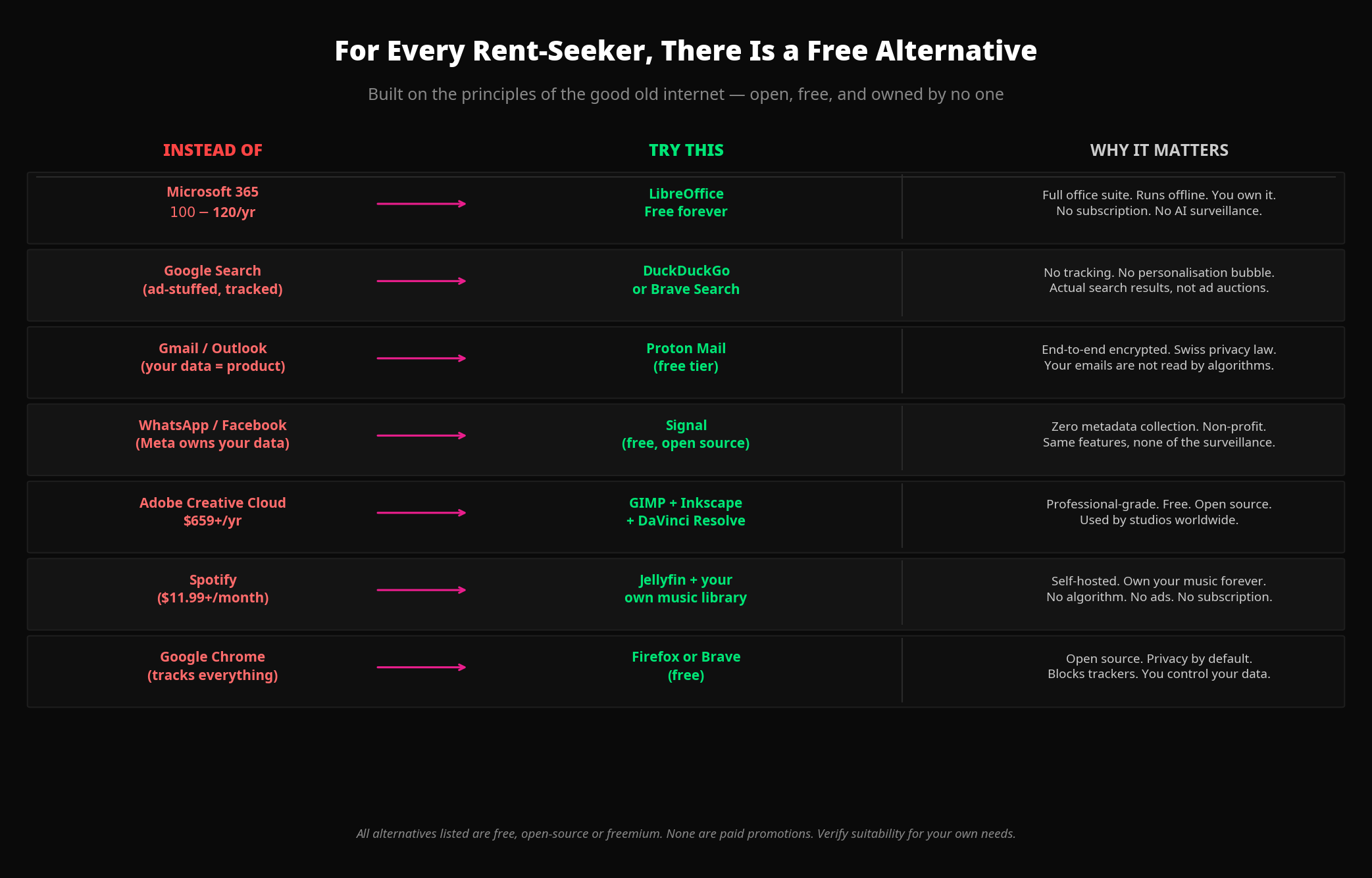
All alternatives listed are free, open-source or freemium. None are paid promotions. Verify suitability for your own needs before switching.
The Indie Internet Is Still There.
RSS feeds still work. Independent blogs still exist. Open-source software is better than it has ever been. Decentralised social networks like Mastodon let you own your own account and take it with you if a platform fails. Proton Mail encrypts your email so that no algorithm can read it. Signal sends your messages without collecting your metadata.
None of these things require technical expertise. They require only the willingness to ask whether the platform you are currently using is actually serving you, or whether you are serving it.
The same instinct that drives financial independence applies here. You do not have to accept the terms that the powerful offer you. You can opt out. You can build something different. And when enough people do, the rent-seekers lose their power.
The Mission
It Is Time to Fight Back.
The same principles that apply to financial independence apply to your digital life. The first step to building wealth that cannot be taken from you is recognising when someone is extracting value from you. The internet is no different. Awareness is the beginning of sovereignty.
Recognise the Extraction
Every time you use a “free” platform, you are the product. Your attention, your data, your behaviour, and your relationships are being packaged and sold. There is nothing wrong with knowing this. There is everything wrong with pretending otherwise.
Demand the Right to Exit
Doctorow’s solution begins with interoperability: the right to take your data and your connections with you when you leave a platform. Lock-in is not a feature. It is a trap. Support platforms and policies that give you the right to leave.
Reclaim Your Information Diet
Algorithms are not neutral. They are designed to keep you engaged, not informed. Seek out direct sources. Subscribe to newsletters. Support independent journalism. Curate your own information environment rather than outsourcing it to a machine optimised for your outrage.
Support Open Alternatives
The open web still exists. RSS feeds, open-source software, decentralised social networks, and independent websites are all still there. Every time you choose an open alternative over a walled garden, you vote with your attention for a better internet.
Understand the Business Model
When a service is free, ask who is paying for it and why. The answer will tell you everything about whose interests the platform actually serves. Follow the money. It always leads to the same place.
Reject Learned Helplessness
The biggest lie big tech tells is that this is inevitable. It is not. The internet was built by humans, and it can be rebuilt by humans. Regulatory action, antitrust enforcement, and individual choices all matter. Your discomfort is not a personal failing. It is a rational response to a rigged system.
“The same instinct that tells you to take control of your money, your business, and your future applies here. Do not outsource your mind to a machine that profits from your confusion.”Bryce AK Jenkins
What’s Next
Reclaim Your Mind.
Reclaim Your Money.
Reclaim Your Life.
The internet is one front in a larger war for your attention, your wealth, and your autonomy. If this page has resonated with you, you are already thinking differently. The next step is to act differently.
Bryce AK Jenkins is a financial adviser, author, and digital rights advocate. The views expressed on this page are his own and do not constitute financial advice. All factual claims are sourced. Where data is illustrative or approximate, this is noted in the relevant infographic captions.